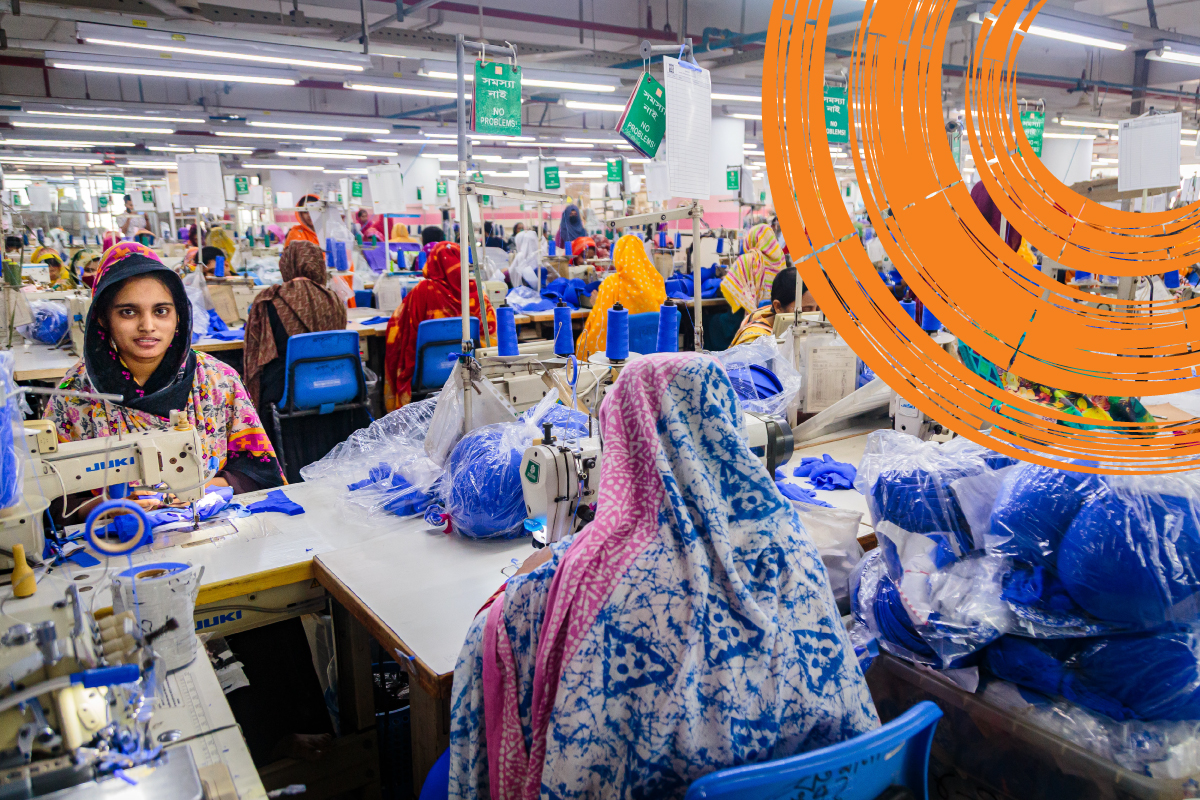
Bangladesh’s growth story is often told through export numbers and factory expansion. Over three decades, the country has become one of the world’s leading garment producers, deeply connected to global supply chains. But that success rests on a fragile foundation.
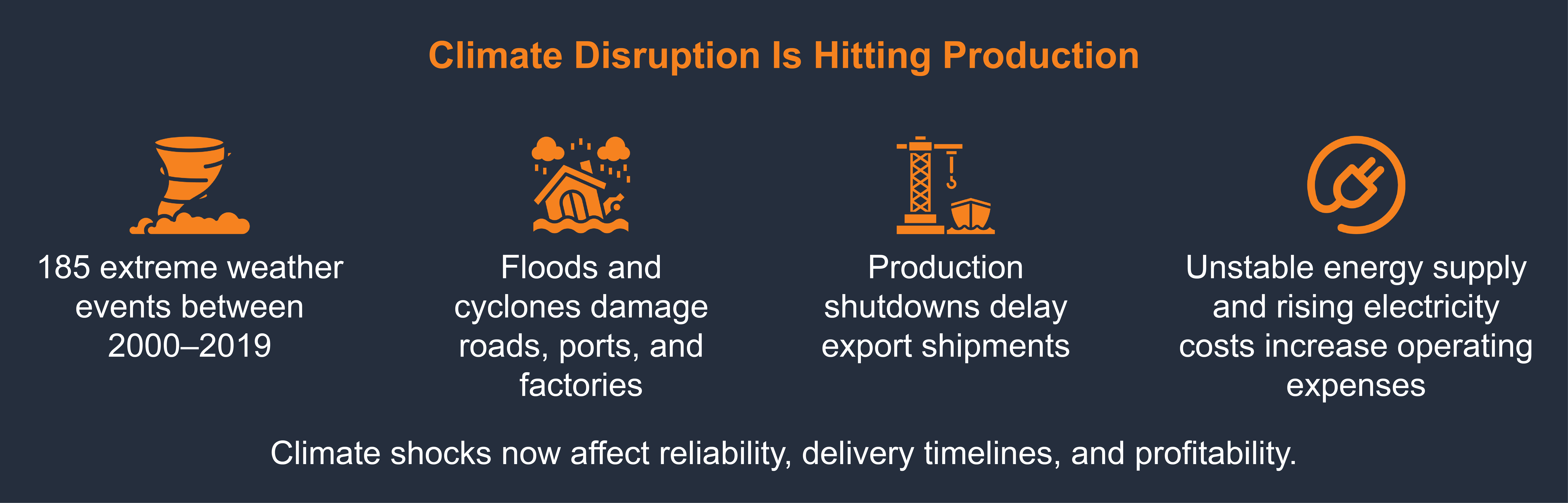
Bangladesh is also one of the most climate-exposed countries in the world. Between 2000 and 2019, it experienced 185 extreme weather events, including floods and cyclones. These are not abstract climate statistics. They flood industrial zones, damage infrastructure, delay shipments, and interrupt production cycles. For a manufacturing-driven economy, climate vulnerability is not just an environmental concern, it directly affects business continuity.
This is where ESG, Environmental, Social, and Governance, enters the conversation.
For many businesses, ESG still sounds like corporate jargon. In reality, it has become a framework used by investors and global buyers to assess how sustainable, transparent, and resilient a company is. Increasingly, it shapes who gets contracts, financing, and long-term partnerships.
In Bangladesh, environmental responsibility is no longer about reputation management. It is about operational stability.
Floods and heatwaves affect productivity. Unstable energy supply and rising electricity costs raise production expenses. Infrastructure vulnerabilities create uncertainty. At the same time, global financial markets are changing. According to the Organisation for Economic Co-operation and Development (OECD), an international policy research body representing major global economies, ESG-linked investment strategies are increasingly influencing capital allocation across emerging markets. Investors are asking companies to disclose climate risks and emissions. Buyers in Europe and North America are under pressure to report the environmental footprint of their supply chains.
That pressure flows downward.
Factories are increasingly asked to provide data on energy consumption, emissions, and resource efficiency. Environmental performance is becoming part of procurement decisions. In a country as climate-exposed as Bangladesh, investing in energy efficiency or renewable power is not simply a sustainability gesture, it reduces disruption risk and strengthens competitiveness.

Bangladesh’s ready-made garment sector employs around four million workers, most of them women. The Rana Plaza collapse in 2013 led to major safety reforms and showed that coordinated change is possible.
But expectations have continued to evolve.
Buyers now look beyond structural safety. They examine labour practices, grievance systems, wage transparency, and workplace culture. Increasingly, they want evidence that these systems function in practice, not just compliance certificates.
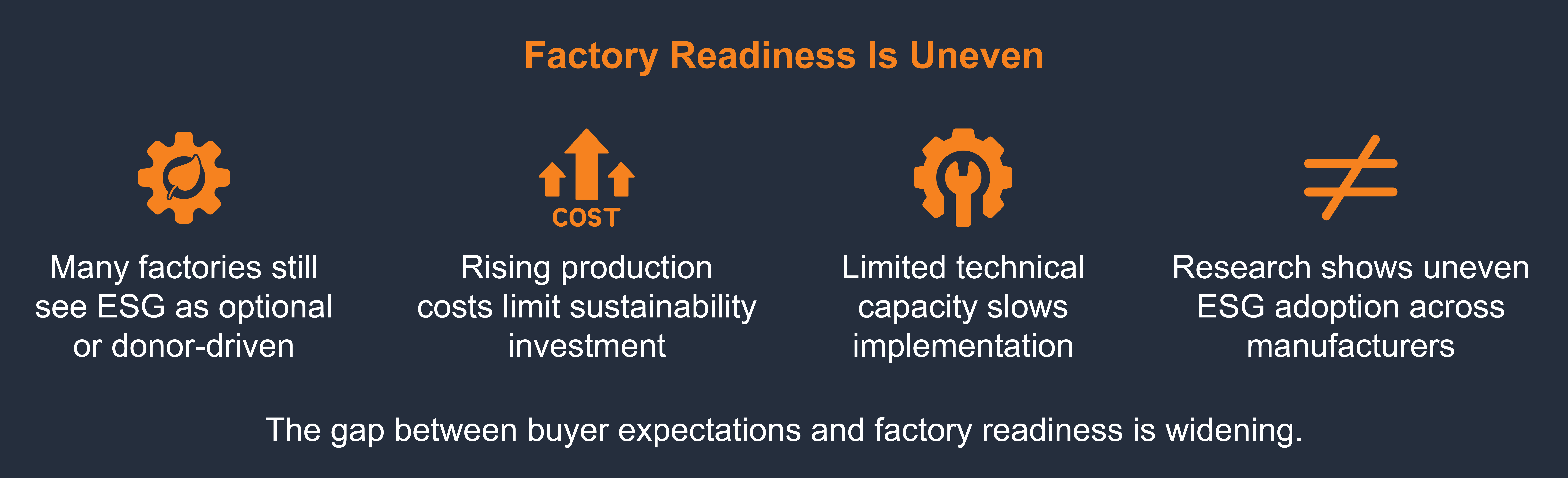
Yet ESG discussions often sound different in boardrooms than on factory floors. When advisory or reporting services are introduced, many management teams see ESG as optional or donor-driven, especially amid rising production costs and tight delivery schedules. Limited technical capacity further slows implementation. Research by Shuvo, Habib, and Raisa on ESG adoption in Bangladesh’s manufacturing sector points to these practical barriers and uneven uptake across firms.
Innovision’s own field experience reflects similar hesitation. But global value chains are evolving quickly. Buyers are demanding verified disclosures and measurable sustainability performance. Factories that adapt early will be better positioned; those that wait may find themselves adjusting under pressure.
Environmental upgrades and labour reforms mean little without credibility. Governance determines whether commitments are trusted.
Bangladesh continues to struggle with institutional weaknesses. The Corruption Perceptions Index 2024 ranked the country 151st out of 180, with a score of 23 out of 100. Weak enforcement and limited transparency can undermine investor confidence and complicate compliance verification.
Within the ESG conversation, governance is often the least visible dimension, but it is the one that holds everything together. Transparent reporting systems, clear accountability structures, and reliable disclosure mechanisms build trust. As global markets become more disclosure-driven, governance quality becomes a competitive advantage.
ESG looks different from inside a factory office. Factory owners are managing rising input costs, tight deadlines, energy instability, and cash flow pressures. Sustainability reporting can feel secondary to keeping production lines moving. The UNCTAD Least Developed Countries Report 2023 highlights the structural constraints that make sustainable transition challenging for many LDCs.
It is therefore understandable that ESG is sometimes viewed as externally imposed.
Yet global supply chains are shifting. Buyers increasingly require traceability and verified disclosures. Financial institutions are gradually incorporating sustainability risk into lending decisions. Factories that move early may find themselves better positioned. Those that delay may face higher adjustment costs later.
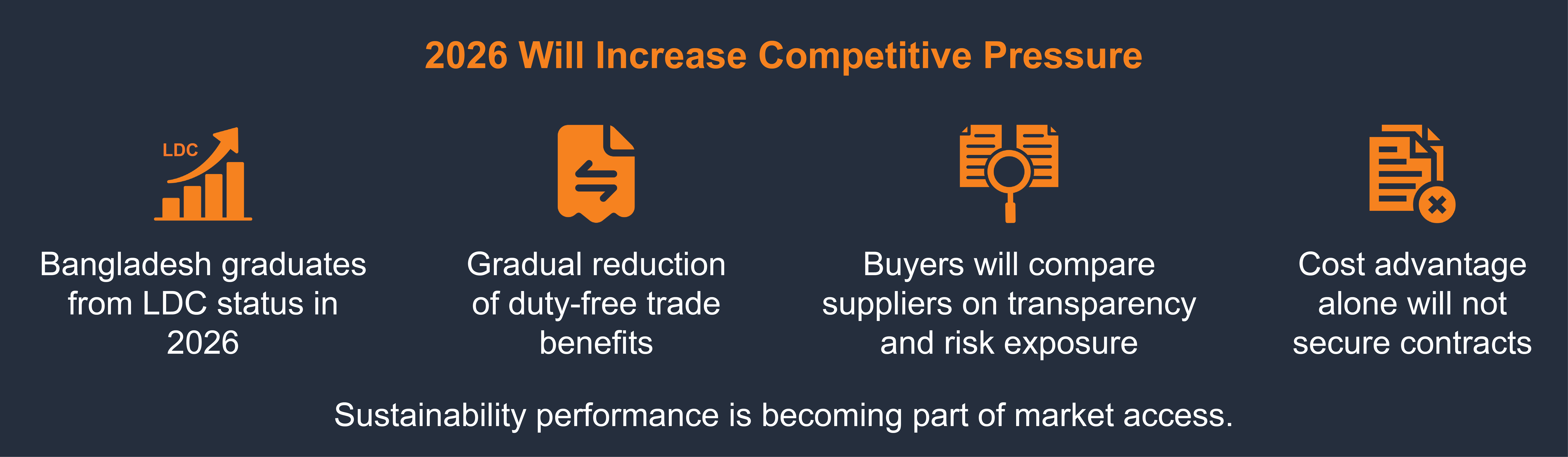
Bangladesh will graduate from Least Developed Country status in 2026. This milestone reflects economic progress, but it also means a gradual reduction in trade preferences, including duty-free and quota-free access to key markets.
When preferential advantages diminish, the basis of competition changes. Buyers will look more closely at productivity, reliability, transparency, and sustainability performance. In that environment, ESG is not an abstract principle. It becomes intertwined with export strategy.
Cost will always matter. But cost alone will not be enough.
The ESG conversation in Bangladesh is maturing. What once seemed like a reputational exercise is becoming embedded in how investors assess risk, how buyers select suppliers, and how regulators design policy frameworks.
Environmental resilience protects operations. Responsible labour practices protect market relationships. Strong governance protects credibility.
For an export-dependent economy navigating climate vulnerability and structural trade transition, these are not optional extras. They are components of long-term competitiveness.
ESG in Bangladesh is no longer a donor-driven concept or a compliance checkbox. It is gradually becoming part of the business logic itself.
The real question is not whether this shift will happen. It already is. The question is how prepared businesses are to respond.
Author: Nusrat Zabeen Radia, an Associate in the Industrial Productivity and Worker's Wellbeing Portfolio at Innovision Consulting
.png)