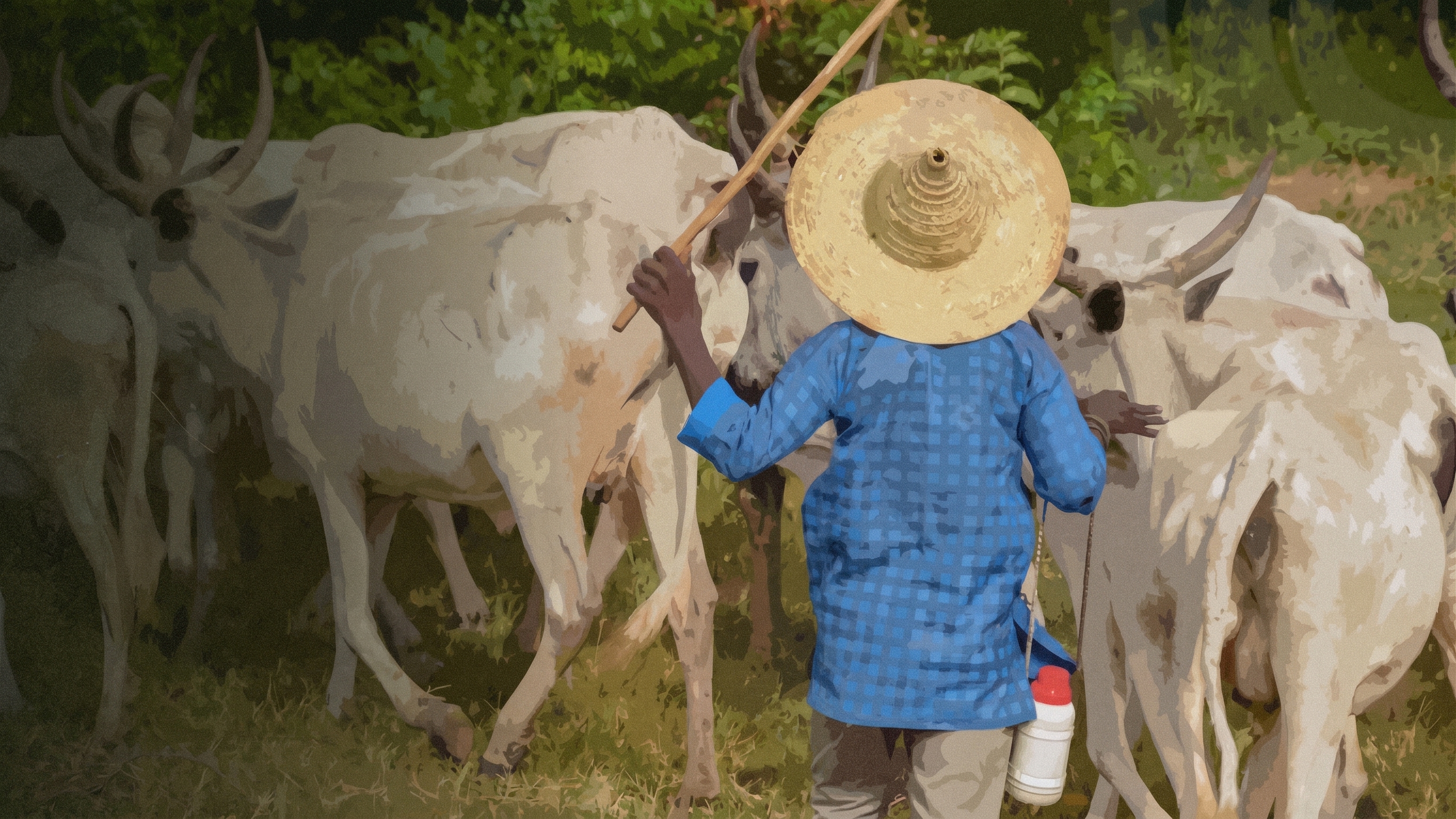
In the second of a two-part series, we explore how Nigeria can move from recognizing the climate risks facing livestock production to building systems that help farmers adapt, improve productivity and reduce environmental pressure.
Nigeria's livestock sector is facing a difficult transition.
Climate change is already affecting the conditions under which livestock are raised, while the sector itself remains a significant contributor to greenhouse gas emissions. The challenge, as the findings of the Synthesis Report on Environmental Impact of Nigerian Livestock Value Chain suggest, is not only to reduce the environmental pressure associated with livestock production, but also to strengthen the systems that help farmers remain productive as conditions change.
For farmers, resilience is rarely an abstract environmental concept. It can mean having feed when pasture is scarce, water when dry seasons become longer, veterinary support when disease spreads, or information that helps them adjust their practices before a climate shock becomes a production crisis.
The report points to several approaches already being tested or implemented in Nigeria. Taken together, they suggest that building a more climate-smart livestock sector may not require entirely new systems. It may depend, in part, on strengthening, connecting and scaling solutions that already exist.
Feed is one of the clearest places where climate adaptation and environmental sustainability intersect.
Nigeria's livestock farmers depend heavily on pasture, hay and other agricultural resources to feed their animals. When climate variability affects pasture availability or quality, alternative sources need to be both accessible and nutritionally adequate.
One approach highlighted in the report is the International Livestock Research Institute's (ILRI) work to convert cassava peels into livestock feed.
Cassava peels have traditionally been treated as agricultural waste, creating disposal and environmental pollution problems. The approach highlighted by the report processes the peels into feed pellets, turning a by-product from one part of the agricultural system into an input for another.
The value of the approach goes beyond finding another feed source.
Repurposing agricultural waste can reduce the environmental impact associated with disposal while increasing the availability of nutrient-dense feed for livestock. The report also highlights potential benefits for animal growth, reproduction, immune function, and milk production, alongside more efficient use of water and land resources.
This points to a useful principle in the report's examples: resilience does not always require finding entirely new resources. Sometimes it means using existing resources differently.
Feed alone cannot make a livestock system resilient.
As Part One showed, disease is already a major constraint for livestock farmers, while access to veterinary services and trained personnel remains limited in many communities.
The report highlights the Community Animal Health Worker model used by Ikore, which focuses on prevention and vaccination and promotes practices such as resilient breeds and improved housing. At the time of the study, more than 600 farmers had benefited from in-kind financing to adopt climate-resilient practices. Ikore also supports activities including feed formulation, soilless farming and compost production as part of its climate-smart approach.
This example highlights a practical challenge in rural livestock systems.
Where farmers are geographically dispersed, resilience cannot depend entirely on services being available in distant centers. Animal health support needs to be accessible close to the communities where production takes place.
The report therefore recommends strengthening veterinary services, training farmers on disease prevention and vaccination, and partnering with organizations such as AmbuVets to expand animal health services in target communities. AmbuVets exemplifies this approach, supporting smallholder livestock farmers with animal health solutions and climate-smart practices, including selecting breeds that can adapt to changing weather conditions.
Another input is less visible than feed, water, or veterinary medicine: information.
The report identifies limited awareness, shortages of specialized experts, and inadequate access to timely information as constraints affecting livestock producers. Farmers may lack knowledge about modern agricultural practices, available support programmes, improved technologies, and sustainable production methods.
This makes agricultural extension an important part of the response described in the report.
A farmer does not only need to know that the climate is changing. They need practical information about what they can do differently: how to manage feed, protect animals from heat, improve housing, manage water, prevent disease, and select breeds better suited to changing conditions.
The report therefore recommends establishing climate-smart livestock extension services and building extension workers' capacity to disseminate climate-resilient practices, particularly in remote communities. It also identifies collaboration with Ikore as one pathway for scaling these services.
The importance of this approach is straightforward. Adaptation becomes more useful when it is translated into decisions farmers can actually make.
The question of livestock breeds adds another dimension.
Productivity has traditionally been an important consideration in breeding decisions. But the report's discussion suggests that adaptability to changing climatic conditions also matters.
Nigeria's National Livestock Breeding Improvement Programme already considers climatic conditions and adaptability in breeding decisions as it seeks to improve indigenous cattle for dairy production.
This points towards a broader understanding of productivity.
The objective is not simply to produce animals that perform well under favorable conditions. It is also to consider how livestock can maintain viable production levels as heat, rainfall, and other environmental conditions become more variable.
In that context, resilience becomes part of the productivity equation.
What is striking about the approaches highlighted in the report is that they do not come from a single institution or intervention.
They address different parts of the livestock system.
ILRI is developing alternative feed from cassava peels. Ikore is strengthening community-based animal health and climate-smart extension. AmbuVets provides livestock health solutions and supports climate-smart practices. The Nigeria Agribusiness Group is promoting improved breeding, efficient feed management, and long-term pasture management through its Climate-Smart Agriculture project.
Each approach addresses a different constraint. But the report's examples also make clear why individual interventions may not be enough.
A farmer may have access to better feed but still lose animals to preventable disease. Another may have veterinary support but lack reliable water. Another may have access to improved breeds but lack the extension support needed to manage them effectively.
The report's recommendations therefore point towards a more connected approach: sustainable sources of feed and water, stronger disease prevention and management, and climate-smart extension services that help farmers access and apply knowledge.
This may be the most important question the report's examples raise.
Nigeria does not need to begin the climate-smart livestock conversation from zero. Approaches already show how agricultural waste can become livestock feed, how community-based animal health services can extend support to rural producers, and how climate-smart knowledge can become part of livestock extension.
The harder question is how these approaches can reach more farmers and become embedded in the systems that support livestock production.
The report points towards partnerships across research institutions, development organizations, private-sector service providers, veterinary professionals, extension systems and farmer communities. Its recommendations include collaboration with organizations such as ILRI, AmbuVets and Ikore.
But scale should not simply mean doing more of the same.
The report's framing suggests approaches need to be understood within their particular contexts, adapted to local production systems, and supported by the infrastructure, knowledge, and partnerships required to sustain them.
That brings the climate–livestock conversation back to systems.
Nigeria's livestock sector faces two pressures at once: reducing the environmental impact of production and protecting farmers and animals from a changing climate. Findings across the two parts of this series suggest these pressures cannot be understood entirely separately.
A climate-smart livestock sector is one that considers environmental sustainability and productive resilience together.
The approaches highlighted in the report offer some indication of what that could involve: better use of agricultural resources, stronger animal health systems, improved access to knowledge, and production practices that account for changing environmental conditions.
The question is no longer whether the sector needs to adapt.
The question is whether the solutions already emerging can be connected, strengthened, and scaled to the required level.
This is Part Two of a two-part series (Part One) based on the Synthesis Report on the Environmental Impact of the Nigerian Livestock Value Chain, prepared by Innovision Global Consulting Limited for Heifer International Nigeria in August 2023.
Author: Divine Nwoye, Communications Associate, Innovision Consulting Africa.