Somewhere in Dhaka, probably right now, a woman is holding a bottle of mustard oil up to her phone camera and telling forty-seven live viewers that this brand (cold-pressed, sourced through a supplier she declines to name because that is proprietary information) will not be available at this price again. She has a packet of imported washing powder ready for the upsell. The comments are filling with fire emojis. Someone types "bhabhi, keep two for me." There is no gavel, no auction house, no overhead. There is a phone, possibly a ring light if she has invested wisely, and an audience that has learned to trust her more than they trust the shop at the end of the lane.
This is f-commerce, Facebook-based retail, and it is one of the more remarkable economic shifts in recent Bangladeshi history. It requires no registered business, no collateral, and no bank appointment. Since the pandemic, women have led the charge: according to Meta, 70 percent of Facebook-based businesses opened in Bangladesh after March 2020 were founded by women,1 and 40 percent of Facebook entrepreneurship groups in the country were created by women.2 What began as a lockdown improvisation (the formal economy shut, the Facebook lives became the storefront) matured into a genuine commercial institution. Women who started by selling cooking oil, spice packets, and household staples from their kitchens are now the primary breadwinners in their households. Husbands, initially skeptical of a wife conducting business at full volume from the living room, have quietly updated their views. The fire emojis kept coming. The money was real.
.jpeg)
The model works because it bypasses every formal system that was supposed to support women's entrepreneurship but rarely did. Microcredit expanded access to capital for millions of women but left the market problem largely unsolved. A loan is not a supply chain. It does not tell you what to stock, where to source it, or how to price against the shop two streets over. F-commerce sellers solved this through intuition, supplier relationships built over years, and the particular genius of the live format, which converts scarcity into urgency and personality into brand equity. It is Sotheby's, but the lot is a family pack of detergent.
What f-commerce has not solved is its own informality. The supply side remains patchy, delivery depends on personal networks, and bookkeeping (where it exists at all) is approximate. The model also travels poorly. The urban seller who built her following over years of daily live sessions is not easily replicated in a village in Rangpur, where the audience is smaller, the smartphone newer, and the camera shyness considerably more acute. The woman who could run a Facebook Live is not necessarily the woman who wants to, and in rural Bangladesh, many who might benefit from the commercial logic of f-commerce have no interest in performing it.
.jpeg)
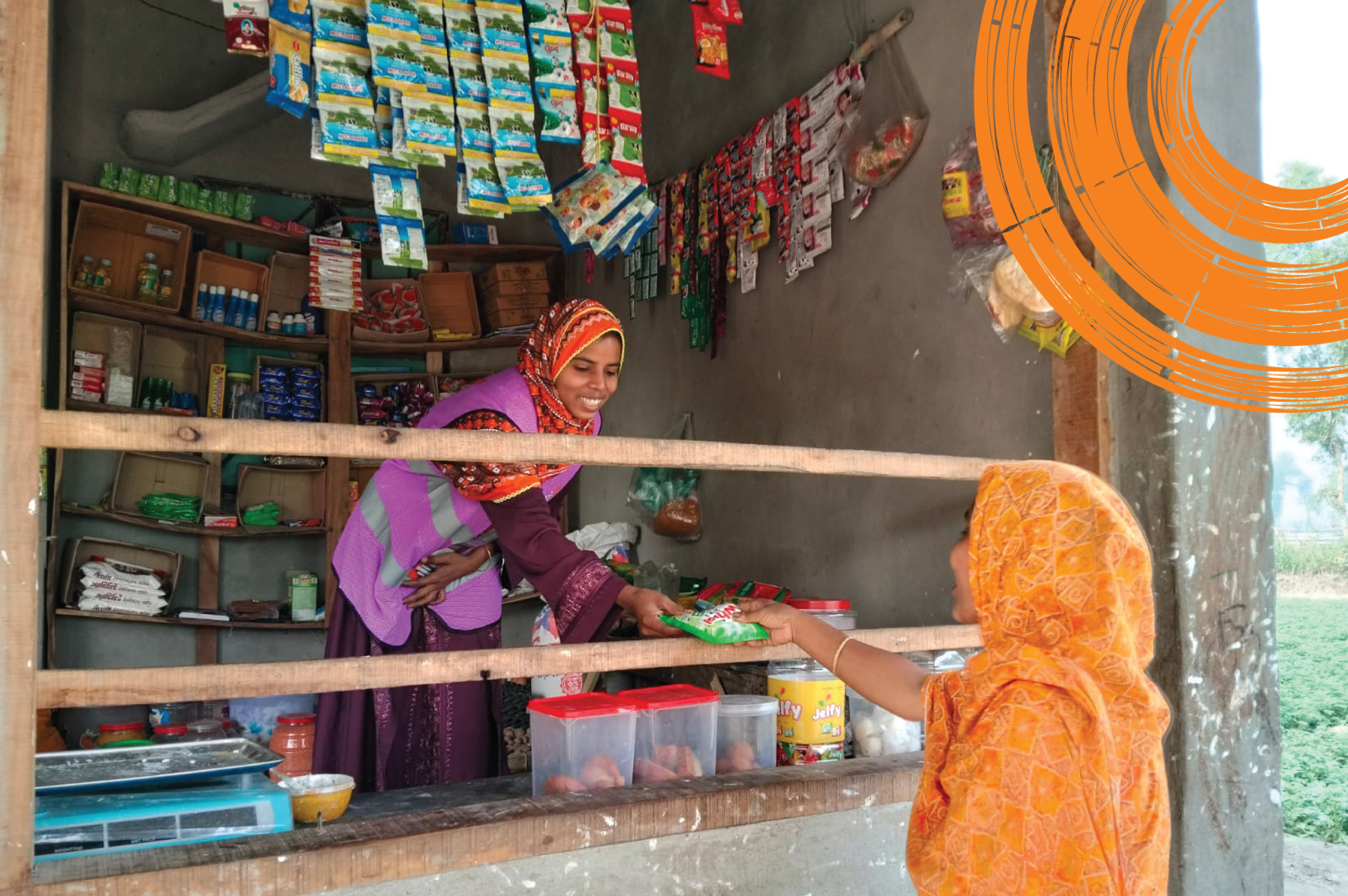
This is the gap the Porshi Project was designed to close. Jointly implemented by ShopUp and Innovision Consulting, and funded by Mastercard Strive and the Gates Foundation, Porshi gives women in Rangpur and Dinajpur access to the same ecosystem that urban f-commerce sellers built informally: a curated catalogue of fast-moving consumer goods (cooking oil, washing powder, household staples) sourced directly from manufacturers through ShopUp's Mokam platform, delivered to their door, and sold within their own communities. No live auction required. Innovision led the fieldwork: recruiting and training over 3,800 women in business fundamentals, digital literacy, and, critically, actual bookkeeping.3 The Porshi entrepreneur is not performing commerce. She is conducting it, with records.
The results among women who stayed with the platform are unambiguous. Ninety-four percent reported an increase in monthly income. Influence over major household financial decisions rose from 33 percent to 87 percent. Family recognition of a woman's work as economically valuable climbed from 9 percent to 95 percent, reaching 100 percent in Rangpur.3 The husbands updated their views here too. What Porshi adds to the f-commerce story is structure: a formal earning channel, a documented business, and the beginnings of a credit history that the informal economy, for all its vitality, cannot produce. The fire emojis were always optional. The income was the point.
.jpeg)
Sources
1. Meta, International Women's Day Press Release, March 2022. Reported by The Daily Star: thedailystar.net
2. Ibid.
3. Innovision Consulting Private Limited. Porshi: Supporting Women Entrepreneurs to Become Mobile Micro-Retailers — Final Report. Submitted to ShopUp, May 2026.
Innovision Consulting Private Limited led field implementation, evaluation design, and capacity building for the Porshi Project. info@innovision-bd.com | www.innovision-bd.com
.png)