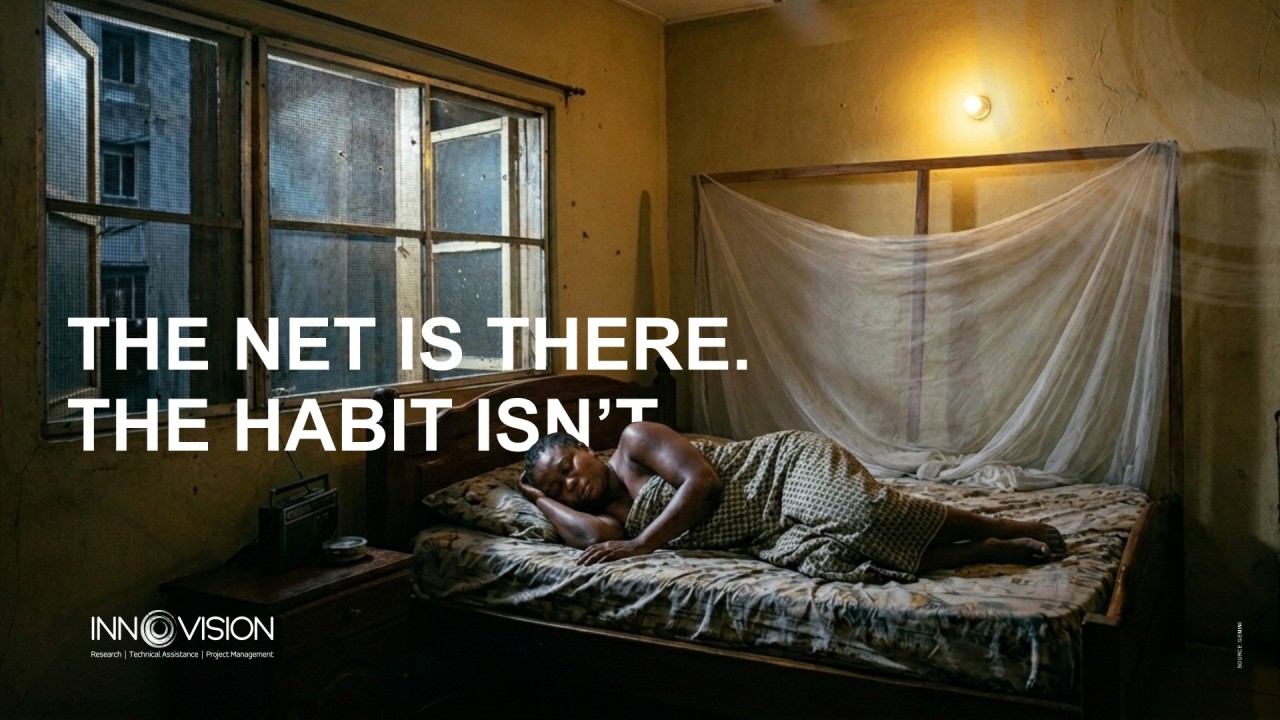
It's a hot night in a typical Nigerian home. The fan is running, the air is heavy, and somewhere in the room, a mosquito net hangs loosely or sits folded in a corner. Everyone knows it works. In fact, most people prefer it. But it's uncomfortable in the heat, so they sleep without it. A few days later, someone has a fever. This is how malaria really lives in Nigeria, not as a distant health issue, but as a quiet, repeated pattern inside everyday decisions.
Recent multi-state field research conducted by Innovision Consulting Africa in collaboration with Malaria Consortium, spanning Kano, Lagos, Rivers, Borno, Abuja, and Anambra, makes this reality clear: only 13.9% of households reported no malaria in the last three months. For most families, malaria isn't occasional. It's routine.
But the deeper story is not just how often malaria happens. It's why it keeps happening. The same research shows that 57.3% of people prefer mosquito nets, yet consistent use drops because of heat, discomfort, and access. At the same time, rural households face significantly higher exposure (46%) compared to urban households (35.5%), shaped by environmental factors like stagnant water, poor drainage, and limited infrastructure. So even when people want to prevent malaria, both behaviour and environment work against them. What looks like a health challenge on paper is, in reality, a mix of small daily trade-offs: comfort versus protection, cost versus necessity, convenience versus consistency.
And this is where the pattern deepens. Prevention tools exist, but the most preferred solutions are not always the most accessible, and affordability makes consistency even harder for lower-income households. The system is not broken in one place. It is slightly misaligned everywhere. Behaviour, market availability, and living conditions are not working together, and that gap is where malaria thrives.
This is the story the data is telling us as World Malaria Day approaches, not just that malaria persists, but that it persists because everyday life and prevention are not fully aligned. The implication is simple but uncomfortable: we don't just have a malaria problem, we have a usage problem. Closing this gap means shifting focus from distributing tools to ensuring they fit into how people actually live; from measuring access to driving consistent use; from isolated interventions to systems that connect behaviour, affordability, and availability.
Because a mosquito net only works if someone sleeps inside it.
The data points to all three. But in your experience, which barrier comes first — behaviour, access, or affordability? Drop your thoughts below.
Note: This article is based on research conducted by Innovision Consulting with support from Malaria Consortium. The Innovision team led the field research, data collection, and analysis. All data cited is drawn from the Nigeria Malaria Market Study.
.png)