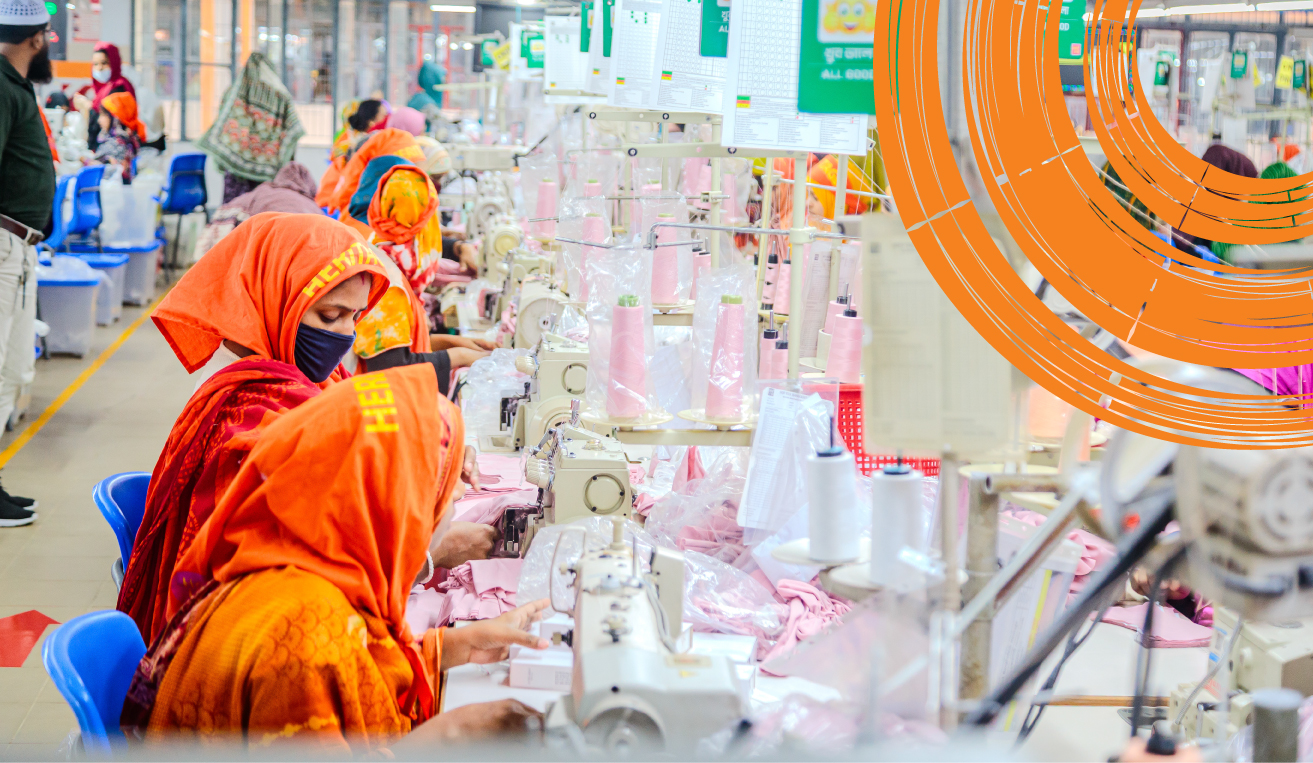
It’s early morning, and the factory floor is in full swing, buzzing with the hustle and bustle of the day’s activities. Amid this chaos, Rabeya silently takes her seat at her sewing machine. She looks at the whiteboard above her line, where the production target for the day is written. Throughout the day, she races against time to meet her targets. The pressure to perform and the fear of losing her job cause her anxiety to grow. Yet, when she returns home, there will still be cooking, cleaning, and caregiving to finish. Sleep comes late and lightly.
Rabeya’s story is not unique. It reflects the reality of the lives of many women in Bangladesh’s garment sector, where mental health struggles take a back seat, and household responsibilities add to the burden.
According to Bangladesh Garment Manufacturers and Exporters Association (BGMEA), women make up 80 percent of the 4 million workers employed in factories, which translates to 3.2 million women workers. The industry’s workforce is shaped by the presence of inexpensive labor, with 80% of its employees being poorly educated women from rural regions.
Research by ILO (2020) reveals that the majority of women workers in the RMG sector previously worked in family roles (42.1%), were unemployed (29.8%), or were students (23.2%). For 95% of them, the sector provided their first paid employment, allowing them a chance to improve their livelihood and transforming their roles from unpaid family labor to income earners. Despite higher pay compared to other jobs at a similar level, they still face elevated mental health challenges, which can be attributed to the modality of the work, work environment, and the distance from their families.
Depression is the leading psychological issue for 69% of female garment workers, often showing up as stress, sleep disturbances, and feeling of worthlessness. Mood disorders, affecting 59% of these workers, cause both emotional and physical symptoms, leading to drastic mood shifts. Phobia, being rooted in occupational safety hazard, is common in 50% of the workforce, while 48% suffer from anxiety due to overwork, mistreatment, and sexual assault. The burden on female workers is ever on the rise, with the pressures of working at the factory, on top of fulfilling family demands at home.

Production Targets and Stress
Factory work is heavily target-driven and workers are often evaluated by output per hour. In industry settings, psychosocial risk factors involve high-job demand and low decision-making control. Machine breakdowns or material delays, issues way beyond workers control, still affects their target and triggers stress and anxiety.
Long Working Hours and Exhaustion
Peak seasons bring with them the reality of long shifts. Extended work hours often result in sleep disturbances, higher levels of stress, and emotional exhaustion, with little or no recovery time.
Balancing Work and Family Responsibilities
Even though employment provides economic empowerment, it does not automatically reduce the domestic workload for women. This “double burden” from both the factory and the household leaves little room for self-care, which exacerbates fatigue and emotional strain.
Financial Insecurity
A single day of absence, a delayed target, or a family emergency can result in pay cuts and disrupt household stability, leading to chronic financial stress. This financial instability is strongly linked to anxiety and depression, as these workers fear losing their only source of income.
Gender Inequality in Career Advancement
Depression and anxiety elevate among female workers when they face unfair treatment regarding career progression. This includes delayed compensation increases, postponed promotions, and limited access to preferred job postings, despite performing the same tasks as their male counterparts.
Sexual Harassment and Disrespect in the Workplace
Male co-workers often fail to treat women with appropriate respect at work and frequently engage in verbal abuse. On top of that, owners, supervisors, and managers often have nefarious intentions of satisfying their sexual needs by exploiting female employees.
For most women garment workers, mental health support is either simply unavailable or systematically out of reach. Frequent overtime leaves little time for workers to seek support, and even if they decide to get help, a clinic visit can cost them a day’s wage. Factory clinics exist but rarely function as real healthcare system. Clinics frequently lack necessary equipment, adequate staff, and operational funds. These limitations reduce the ability of professionals to provide quality care to workers, particularly when issues go beyond quick check-ups. Consequently, treatment often stays confined to minor ailments such as cold and coughs.
Even when a worker needs more serious care, referral pathways to lower-cost government hospitals are often unclear or unavailable. Stigma presents an additional barrier and is frequently rooted in gender-based norms and discrimination. Fear of gossip and rumors, fear of job-related consequences, a lack of empathetic behavior from service providers, and limited private space and confidentiality further narrow the path for women to seek help. Over time, silence becomes the coping strategy.
Any real solution doesn’t ask women to step out of their lives. These solutions meet them at work or at the boundary of home life. Educational workshops and incentives can encourage men to step up and share the burden of household responsibilities alongside women. Visible community-level initiatives can reframe women’s labor as dignity and treat their mental health as a serious concern, and not just a side issue.
Low-cost housing, childcare support, and paid maternity leave can reduce daily pressure on female workers, lowering stress levels over time. Fair targets, respectful supervision, regular breaks and an environment where women have voices are not less important than any formal policy.
Private on-site spaces, mobile or hotline support that protects women’s identities, regular awareness sessions and clear referral pathways to affordable care outside the factory will make mental health support more trusted and easier to access. Rules regarding compensation, overtime, harassment reporting and non-retaliation have to be enforced accordingly, not just written. Female workers will tend to refrain from seeking help if the price is gossip, punishment and job loss.
Finally, collaborative effort of different stakeholders can potentially increase funding for mental health support and improve training materials. Joint sessions with workers, employers, and healthcare providers can build awareness and the skills needed to identify distress and respond appropriately. In parallel, strengthening labor law enforcement and ensuring decent workplaces are essential to make these improvements real.
1. Nasrullah, N. M., & Rahim, M. M. (2014). CSR in Private Enterprises in Developing Countries. https://ssrn.com/abstract=2647086
2. ILO. (2020). Understanding the Gender Composition and Experience of Ready-Made Garment (RMG) Workers in Bangladesh. https://www.ilo.org/sites/default/files/wcmsp5/groups/public/%40asia/%40ro-bangkok/%40ilo-dhaka/documents/publication/wcms_754669.pdf
3. Rahman, R. I., & Islam, R. (2013). Female labour force participation in Bangladesh: trends, drivers and barriers: International Labour Organization, DWT for South Asia and Country Office for India. https://www.ilo.org/sites/default/files/wcmsp5/groups/public/%40asia/%40ro-bangkok/%40sro-new_delhi/documents/publication/wcms_250112.pdf
4. Akter, S. (2019). Health and nutritional status of female garment workers in Bangladesh. In Conference Paper, presented at International Nutrition in Germany. https://www.researchgate.net/publication/335927904_Health_Nutritional_Status_of_Female_Garment_Workers_in_Bangladesh_Submitted
5. Haque, M. F., Sarker, M. A. R., Rahman, M. S., & Rakibuddin, M. (2020). Discrimination of women at RMG sector in Bangladesh. Journal of Social and Political Sciences, 3(1). https://www.researchgate.net/publication/339290742_Discrimination_of_Women_at_RMG_Sector_in_Bangladesh
6. The Financial Express. (2025). Mental health challenges of female RMG workers. https://thefinancialexpress.com.bd/views/views/mental-health-challenges-of-female-rmg-workers
Author: Arsia Tabassum Kabbya, an Associate in the Gender and Basic Services Portfolio at Innovision Consulting
.png)