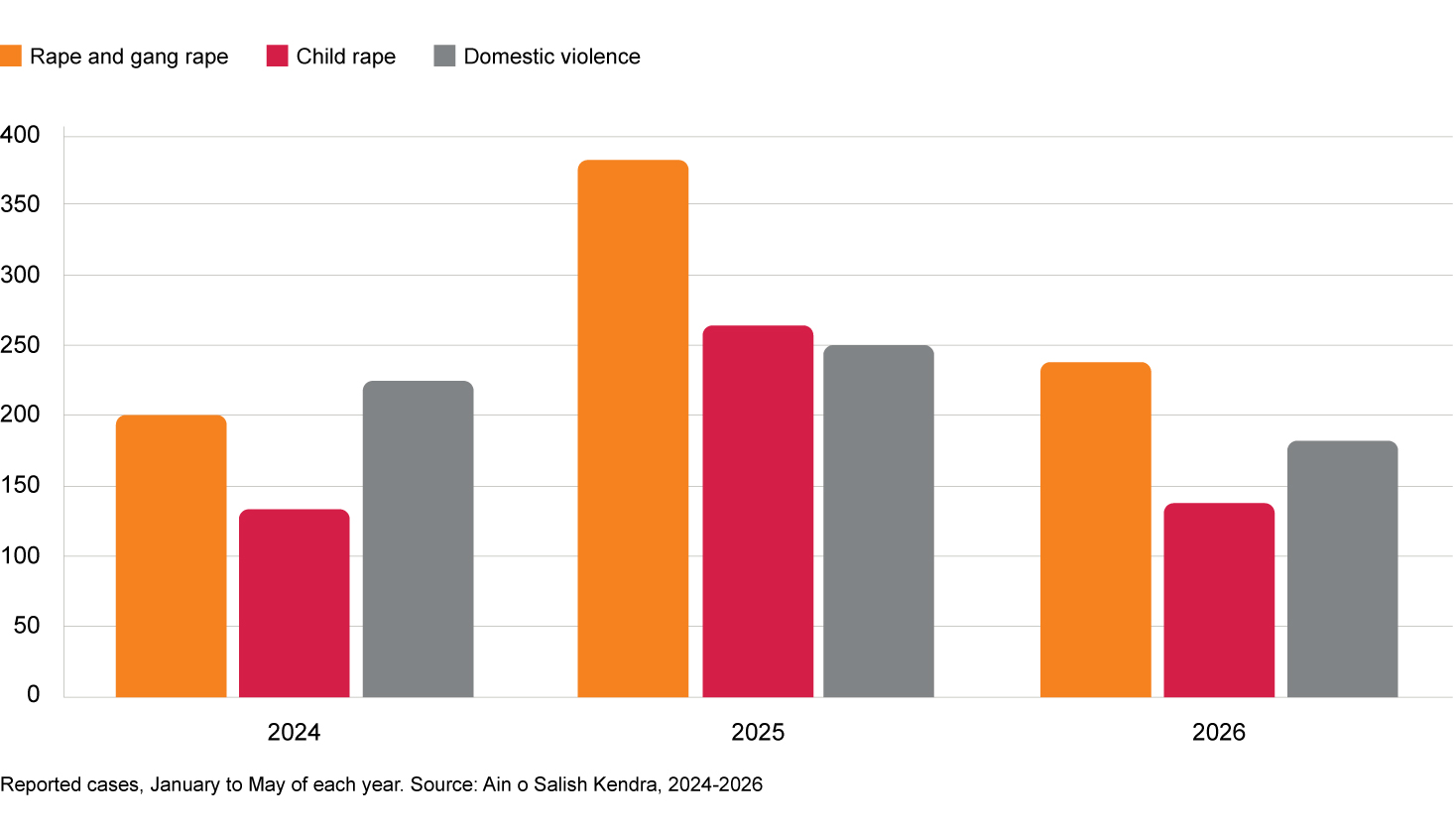
Reported cases of gender-based violence in Bangladesh nearly doubled between the first five months of 2024 and the same period in 2025, then eased slightly by 2026, though the figures still sat well above where they started. The shape of that curve matters more than any single year's total, because it rules out the easiest explanation. This isn't a spike. It's a condition that has outlasted three separate reporting cycles, and nothing about tracking incident counts alone is going to resolve it.
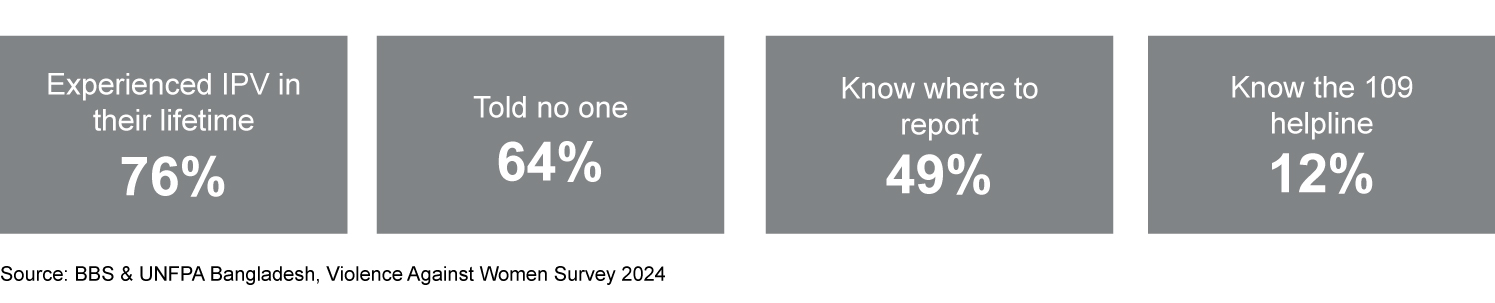
A 2024 national survey gives some sense of what sits underneath those numbers: 76 percent of women said they had experienced intimate partner violence at some point in their lives, and two in three of them had never told anyone. That gap, between what women actually live through and what shows up in any dataset, is really the subject of this piece.
Neither the rising incident numbers nor the underreporting proves causation on its own. Together, though, they point toward something specific: gender bias, unequal power inside relationships, and institutions survivors have learned not to trust.
Social norms are the unwritten rules communities use to decide what counts as acceptable, and they get reinforced constantly, in households, classrooms, workplaces, on public transport. Researchers studying sexual harm have long described it as a continuum rather than a single event: it starts with things routinely waved off as ordinary (a stare held too long, an unwanted comment) and stretches, at its far end, toward coercion and outright violence. Left unchallenged long enough, that continuum produces what's been called "rape culture", not the idea that most men are violent, but an environment where male aggression is treated as background noise rather than a choice someone made.
Humor turns out to do a lot of the work here. Jokes that demean a group make discrimination against that group feel gradually more permissible, and experimental studies back this up: exposure to sexist humor measurably increases tolerance for discriminatory behavior, especially among people who already lean toward hostile sexism. What matters isn't really the joke itself. It's the silence that follows it. Every time a remark gets laughed off instead of challenged, it confirms, quietly, that there's no real cost to it.
That dynamic doesn't stay confined to public life. A study of young female domestic workers in Dhaka found that informal employment, dependence on employers, and norms around women's sexuality and family honor left these workers with almost no good options when facing harassment. Few filed formal complaints. Most avoided, negotiated, or simply left the job, because a sexualized comment from an employer isn't only offensive, it carries real weight when your income and reputation depend on staying quiet about it.
Patriarchy works across several linked domains at once, paid work, household labor, sexuality, culture, violence, the state, and male dominance gets sustained through all of them together rather than any single one. Once you see it that way, violence against women stops looking like an aberration and starts looking like one enforcement mechanism among several, sitting alongside things like women's economic disadvantage and their limited access to political power.
In everyday relationships, that structure often looks like control: limits on where a woman can go, what she can spend, who she can talk to. Because none of that necessarily involves physical force, it's frequently not recognized as coercion, not by the women living with it, and not by whatever system is supposed to respond to it. That's worth taking seriously, since comparative research links controlling behavior to a much higher likelihood of physical or sexual violence down the line. In Bangladesh, 67.6 percent of ever-married women report having experienced this kind of control from a partner at some point.
Two-thirds of women who experienced physical or sexual violence from a husband told no one at all. Fewer than half the country's women know where they'd even report violence if they wanted to, and only 12 percent have heard of the government's 109 helpline. Given all that, silence starts to look less like passivity and more like a reasonable read of the odds, one that gets reinforced every time a survivor who does speak up is blamed, doubted, or simply ignored. Each of those responses teaches the next survivor that coming forward costs more than it delivers.
Formal justice doesn't do much to change that math. A joint review by Bangladesh's Supreme Court and BRAC looked at 4,040 cases closed between January and June 2025 across 32 districts: a 3 percent conviction rate, a 70 percent acquittal rate, and an average case length of roughly 3.7 years. Those numbers describe only the cases in that sample, not the full national picture, but within it they describe a system that rarely delivers anything timely or credible. When outrage over a high-profile case pushes lawmakers toward harsher sentencing, the death penalty for rape among them, it addresses the act after the fact. It does nothing about the silence and institutional drift that let the act go unpunished for as long as it did, and that gap is really the argument of this piece.

Children are shaped by the same gendered dynamics that constrain women, on top of the dependency and limited agency that come with simply being a child. Research into how child abuse becomes possible in the first place tends to point at the environment surrounding the child, not the child, weak supervision, no real accountability, adults who don't take a child's account seriously when it's given.
Of 139 reported child rape cases in Bangladesh between January and May 2026, 27 involved children six or younger, 60 involved children seven to twelve, and 34 involved children thirteen to eighteen. Age wasn't recorded at all for the remaining 18. That's not a rounding error worth glossing over: incomplete age data makes it harder to design prevention, referrals, or services that actually fit a child's age, which means the record-keeping itself is part of what's failing these children.
Because most of what drives this violence is social rather than individual, prevention has to work socially too. Bystander education programs have shown that communities can learn to recognize harmful norms as they happen and step in. The same mechanism that normalizes sexist behavior through silence works in reverse: visible, repeated disapproval builds a different norm, one where harassment gets challenged instead of shrugged off.
That's the logic behind the WHO and UN Women's RESPECT framework, which treats shifting norms as one piece of a larger strategy alongside relationship skills, women's economic empowerment, accessible services, safer public environments, and child-specific protections. None of these pieces substitutes for the others. Messaging without services, or legal punishment without any shift in norms, leaves the underlying conditions exactly where they were.
Fund social-norm change alongside legal reform. Programs addressing sexist humor, victim-blaming, coercive control, and reputational sanctions belong in workplaces, schools, transport systems, and community settings, evaluated against real shifts in peer approval, willingness to intervene, confidence in reporting, and institutional response.
Hold child-protection systems to existing standards. UNICEF's Child Protection Systems Strengthening approach and WHO's INSPIRE framework already offer concrete benchmarks for whether supervision, referral pathways, confidential reporting, and data systems function in practice rather than just on paper.
Make reporting mechanisms actually usable. With fewer than half of women knowing where to report and minimal awareness of the national helpline, public communication needs to cover not just where to go but what happens next: what confidentiality protects, and what medical, legal, psychosocial, and shelter services exist.
Name who owns what. The Ministry of Women and Children Affairs should coordinate prevention and survivor-support policy. Police, prosecutors, and tribunals should answer for survivor-centered investigation and timely case management. Schools and employers should enforce safeguarding procedures. Local government should strengthen community referral systems, and civil-society organizations should keep contributing survivor expertise and independent monitoring. Every actor here needs a defined responsibility, a measurable indicator, and a public reporting cycle, or none of this moves past the recommendation stage.
Addressing sexual violence in Bangladesh means doing two things at once: changing the norms that make unequal power feel normal, and building institutions actually willing to sanction its abuse when norms fail on their own.
References available on request. For inquiries: info@innovision-bd.com
Author: Arsia Tabassum Kabbya, an Associate in the Gender and Basic Services Portfolio at Innovision Consulting
.png)